Question:
Given a right-angle triangle \triangle ABC as below:
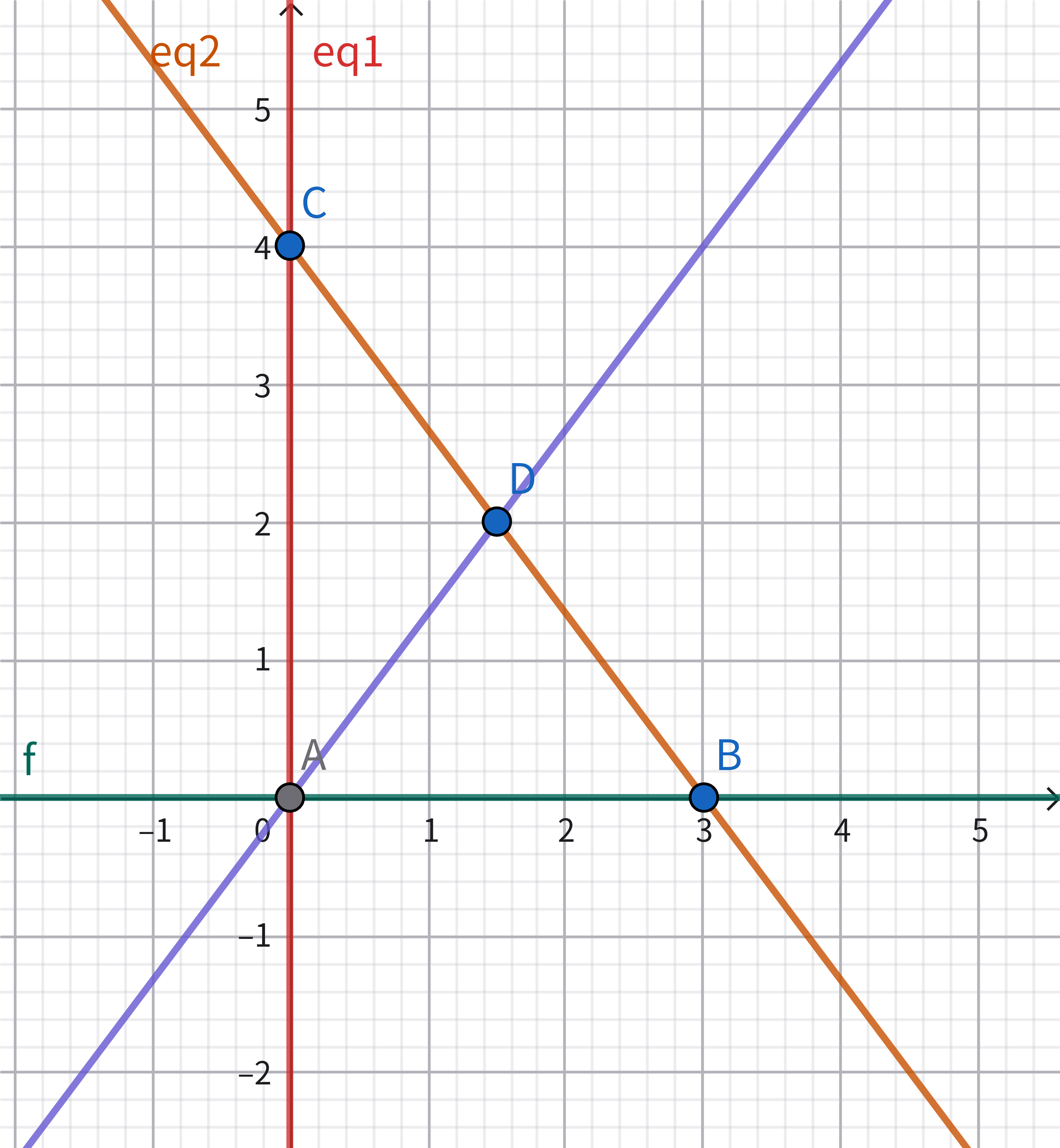
It is known that AB\neq AC and CD=DB=r. Without a ruler, prove that DA=r.
Question:
Given a right-angle triangle \triangle ABC as below:
It is known that AB\neq AC and CD=DB=r. Without a ruler, prove that DA=r.
Solution 1:
Point D is a circumcentre. Hence, AD=BD=CD= the radius= r.
Q.E.D.
Solution 2:
We use the method of contrapositive to achieve the proof. Denote \angle ABC = m and \angle ACB = n. Clearly m+n={90}^{\circ}.
Note that AD is NOT the perpendicular bisector of BC as AC\neq AB. Now denote \angle CAD=p and \angle DAB = q.
Assume AD\neq r, by sine laws:
On \triangle CDA:
CD/sin(p) = AD/sin(n)
On \triangle ADB:
DB/sin(q) = AD/sin(m)
If AD\neq r, we have:
sin(p)\neq sin(n) and
sin(q)\neq sin(m)
Note that sin(p+q)=sin(m+n)=1
We yield p= m or n
and q = n or m
where p\neq q by the assumption that AD is NOT an angle bisector because AD is also NOT a perpendicular bisector.
Now \angle CDA \neq \angle ADB \neq {90}^{\circ}. We will violate this condition if we put p=m and q=n. Then p=n and q=m such that AD=r, which contradicts the beginning assumption that AD\neq r.
Q.E.D.
Note that p,q,m,n are all acute angles so their sine values must be unique.
More: