Question:
Wiki a Math term Convergence and study about the limit of a sequence online, then try to attempt the subquestions below:
(a) Show that 2^n/n! converges to zero when n tends to infinity, given n is a positive real integer.
(b) Hence, show that e < 3.
1個讚
Solution to part (a) :
Denote a sequence s_n = 2^n/n!
common ratio = s_(n+1) / s_n
= (2^(n+1)/(n+1)!)/ (2^n/n!) = 2/(n+1)
For n > 1, taking limit on n, we have 2/(∞+1) = 0
The sequence will converges to zero.
Solution to (b) :
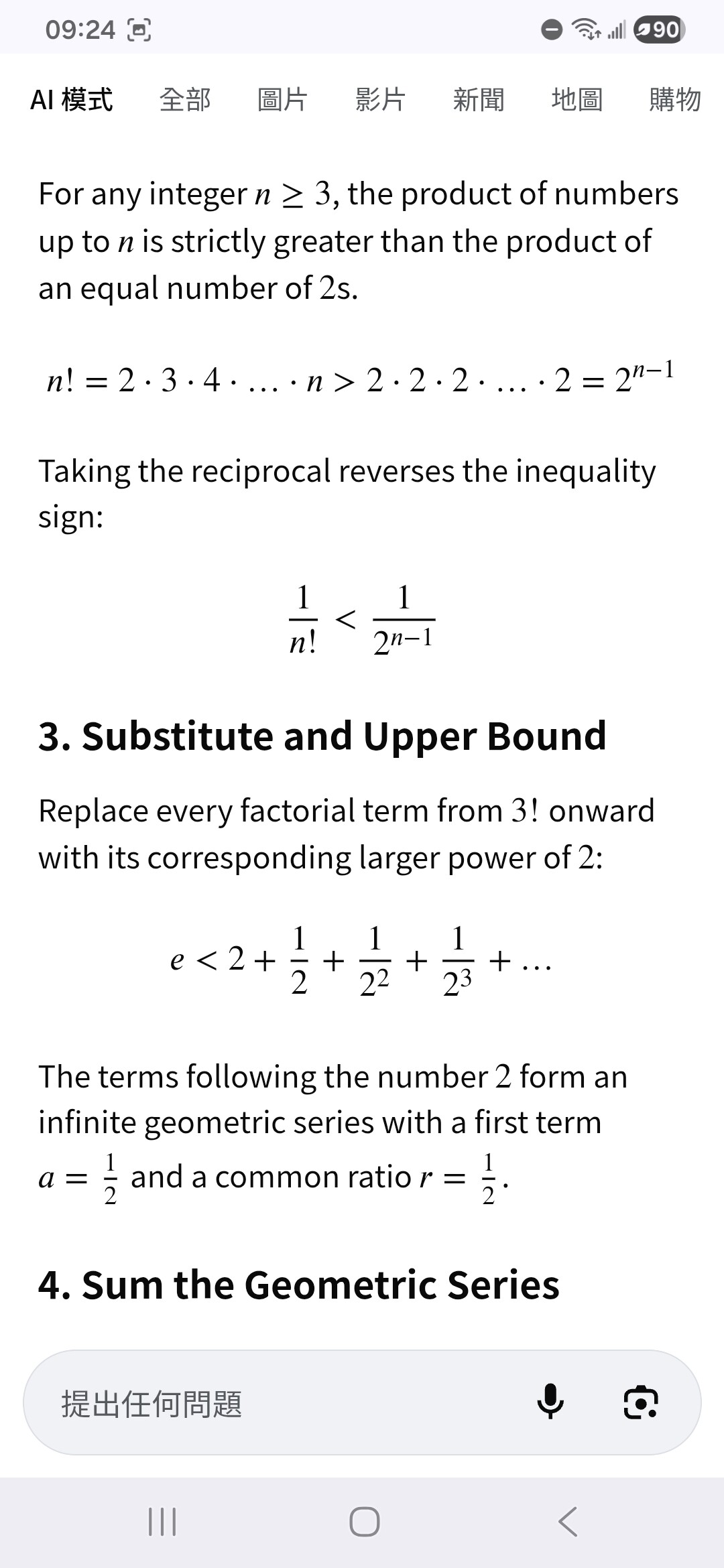
e^x = 1/0! + x/1! + x^2/2! + x^3/3! + …
= 1 + x(1/1! + x/2! + x^2/3! + … )
< 1 + x(1 + x/2 + x^2/4 + …)
= 1 + x( (x/2)^n - 1) / (x/2 -1))
Put x = 1 and n = ∞, we have:
e < 1 + 1/(1 - 1/2) = 1 + 1/(1/2) = 1+2 = 3
Next question:
Find n such that (n-1)! + 1 = n^2,
where n is a positive real integer.
Solution:
For n > 1, (n-1)! must be an even number.
We start iteration of n from 3, 5, and forth,
then we notice that 4! = 5^2 - 1 = (5+1) (5-1) = 24.
Q.E.D.
試下 Mathjex work唔work:
\begin{align*}
e^x &= \frac{1}{0!} + \frac{x}{1!} + \frac{x^2}{2!} + \frac{x^3}{3!} + \dots \\
&= 1 + x\left(\frac{1}{1!} + \frac{x}{2!} + \frac{x^2}{3!} + \dots \right) \\
&< 1 + x\left(1 + \frac{x}{2} + \frac{x^2}{4} + \dots \right) \\
&= 1 + x \left( \frac{(x/2)^n - 1}{x/2 - 1} \right)
\end{align*}
Put x = 1 and n = \infty, we have:
e < 1 + \frac{1}{1 - 1/2} = 1 + \frac{1}{1/2} = 1 + 2 = 3
1個讚
Putting x=2 will yield 2 indeterminates:
1^∞ and 0/0
I wonder how to wipe out the singularity.
Due to the degree of x in the numerator of the geometric sum, the domain of x will be limited to (-2, 2). So, putting x= -3 or 3 will lead to divergent series. The singularity cannot be removed because the degree of x in the denominator is always 1.
BTW, the Mathjax can't save the Latex output as SVG or other image formats.
Right click -> Copy to clipboard -> SVG Image.
I know, but the SVG option is grey and thus can't clicked.
Aha.
It works if you set the Math Renderer to SVG in Math Settings.