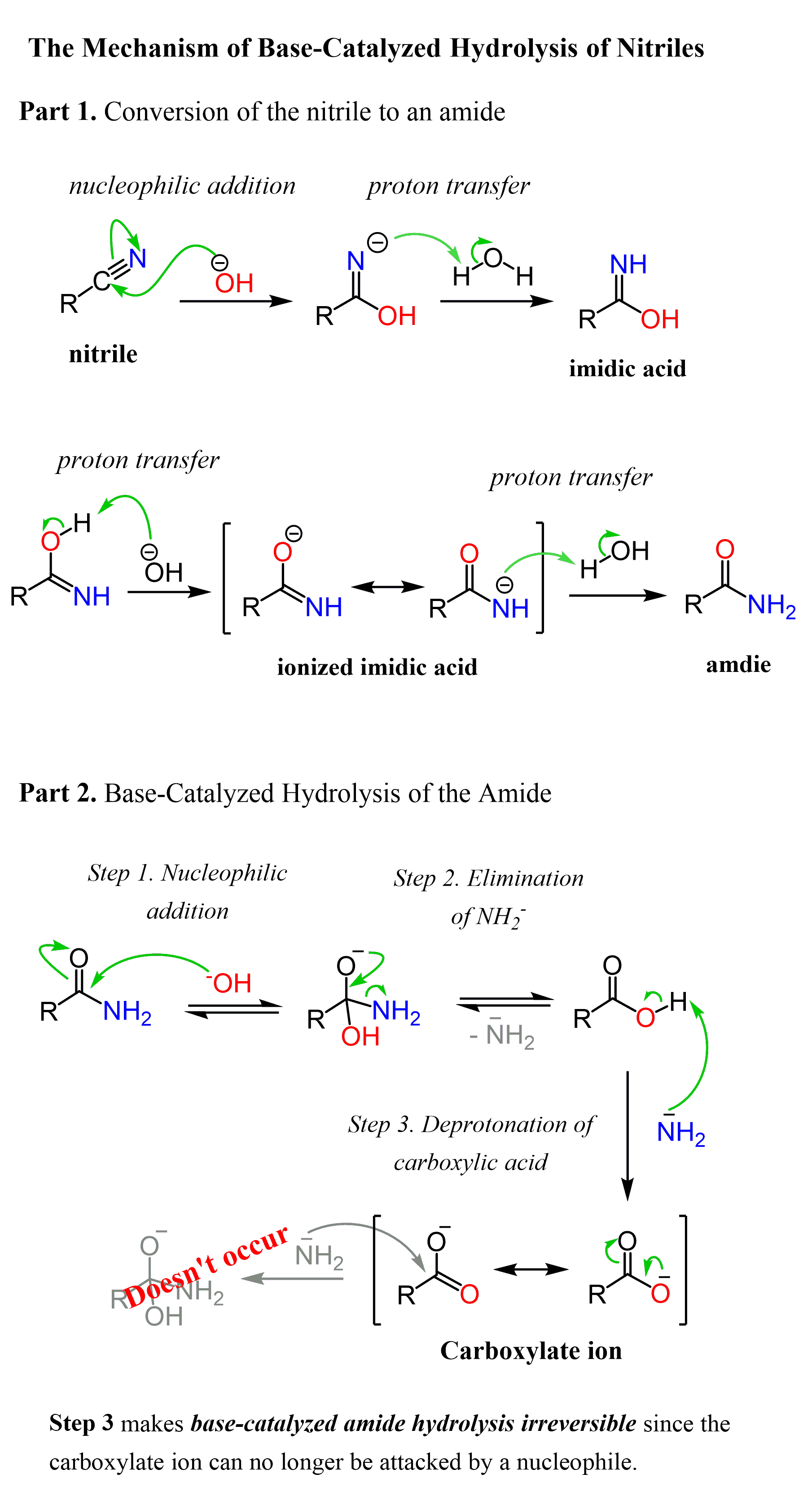
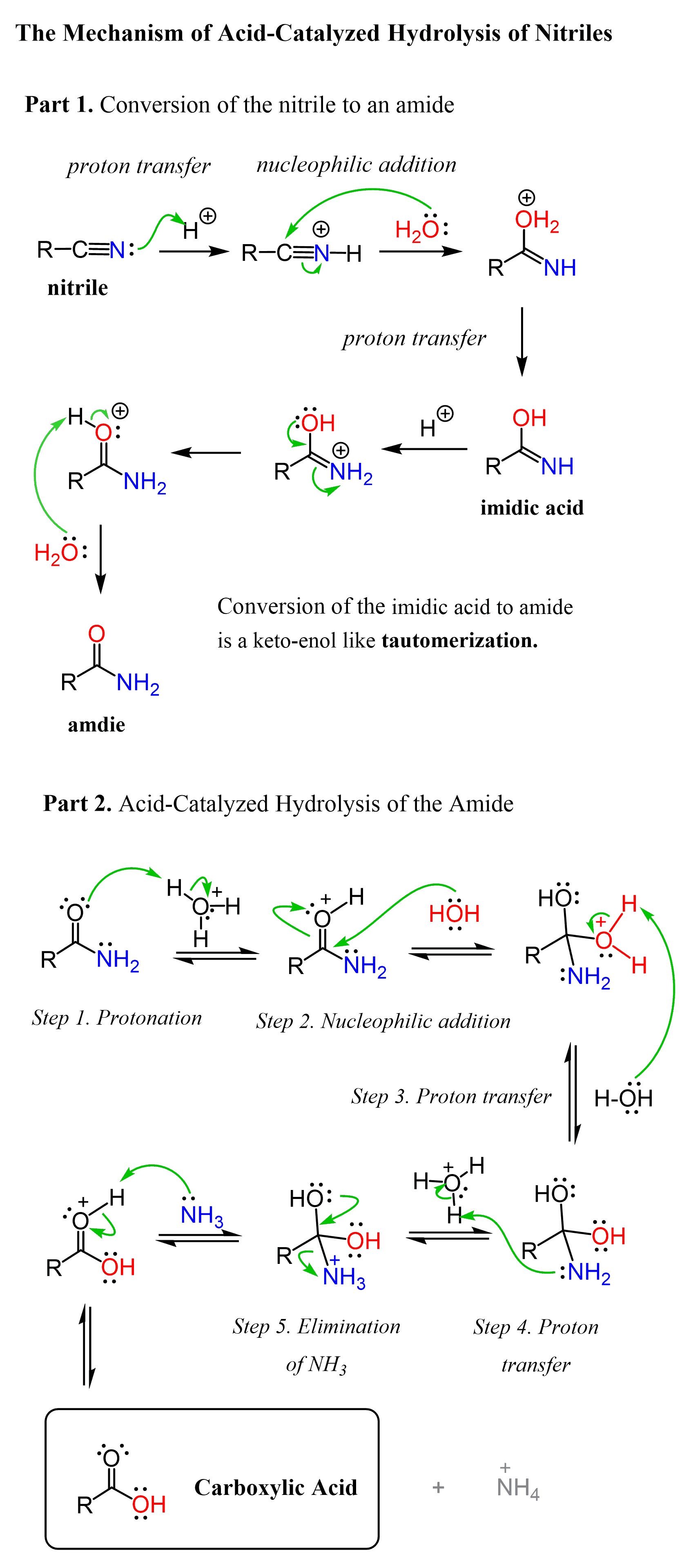
Question: How to hydrolyze nitriles?
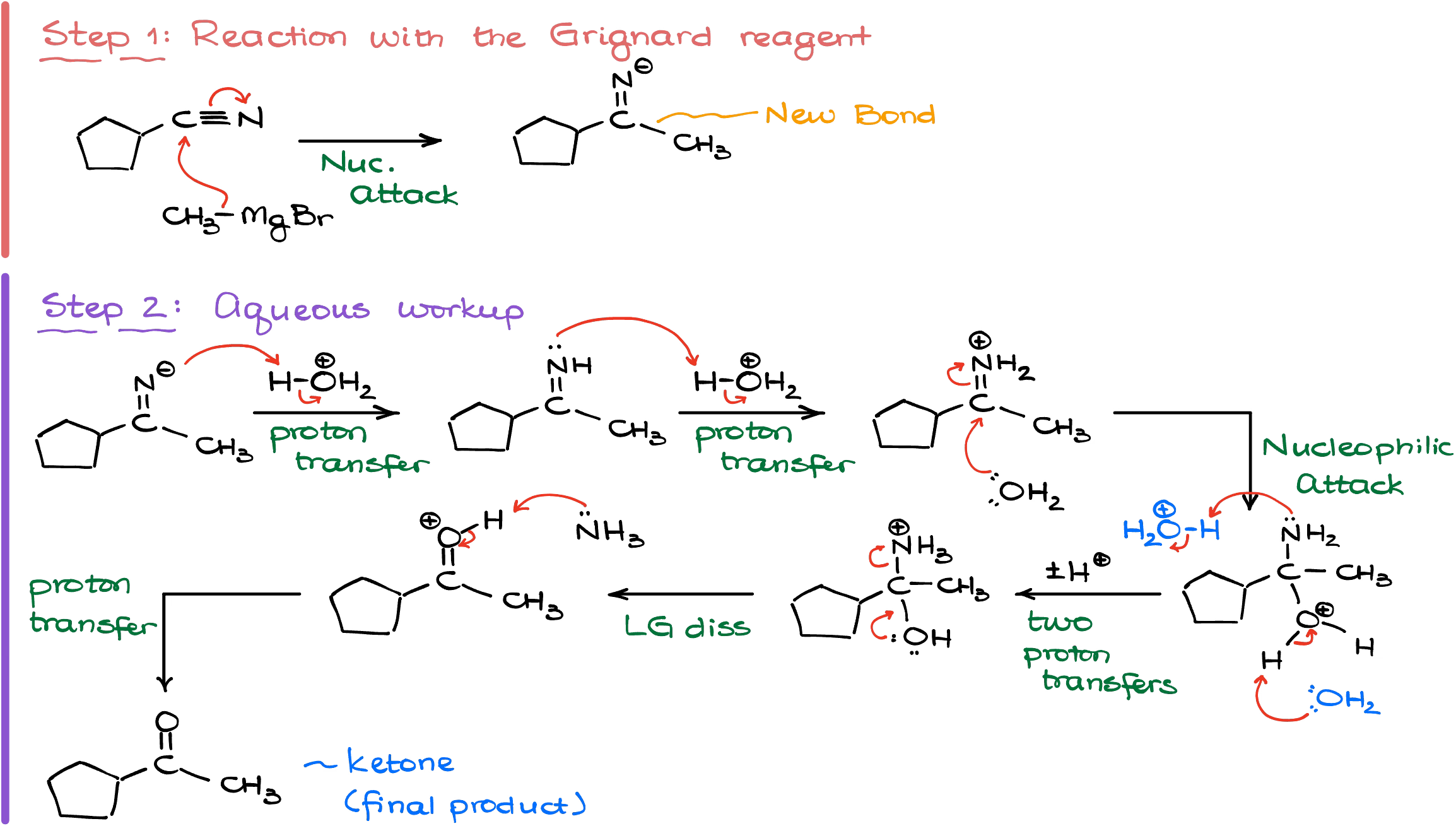
Question: How to add a carbon atom on a nitrile?
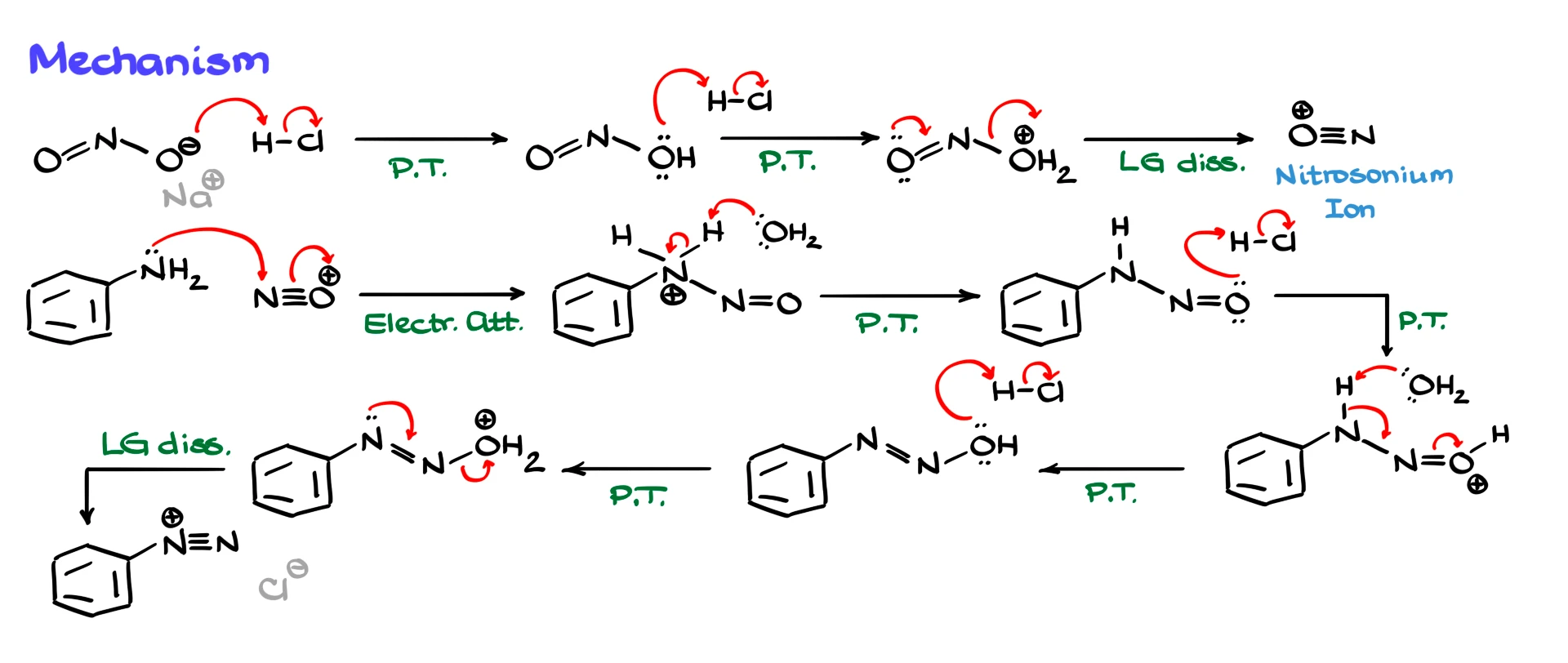
Question: How to make a diazonium salt?
Question: Diazonium group is a good leaving group. Explain how this makes diazonium salt versatile in organic synthesis.
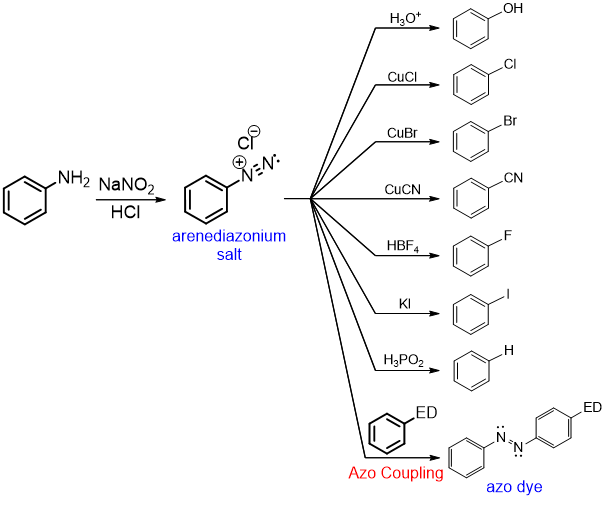
Note that for the reduction to benzene, the reason is different from nucleophilic attack:
The reduction of benzenediazonium chloride to benzene using hypophosphorous acid (H₃PO₂) and water proceeds via a free-radical chain mechanism rather than a polar ionic pathway. [1, 2]
Overall Reaction
\text{C}_{6}\text{H}_{5}\text{N}_{2}^{+}\text{Cl}^{-}+\text{H}_{3}\text{PO}_{2}+\text{H}_{2}\text{O}\rightarrow \text{C}_{6}\text{H}_{6}+\text{N}_{2}+\text{H}_{3}\text{PO}_{3}+\text{HCl}
[1, 2]
Reaction Mechanism
The reaction mechanism involves three main stages: initiation, propagation (radical transfer), and termination.
- Initiation
- Trace metals (such as copper ions Cu⁺ present as impurities) react with hypophosphorous acid (H₃PO₂) or the diazonium salt to generate an initial hypophosphite radical (⋅PO₂H₂ or ⋅H₂PO₂). [1]
- Propagation Steps (Chain Reaction)
-
Hydrogen Atom Abstraction / Electron Transfer: The hypophosphite radical transfers an electron or hydrogen atom to the benzenediazonium ion (C₆H₅N₂⁺).
-
Loss of Nitrogen: The unstable intermediate breaks down, extruding extremely stable nitrogen gas (N₂) and generating a phenyl radical (\text{C}_6\text{H}_5^\cdot):
\text{C}_{6}\text{H}_{5}\text{N}_{2}^{+}\rightarrow \text{C}_{6}\text{H}_{5}^{\cdot }+\text{N}_{2} [1] -
Formation of Benzene: The phenyl radical (\text{C}_6\text{H}_5^\cdot) abstracts a hydrogen atom from a molecule of hypophosphorous acid (H₃PO₂), forming the final product benzene (C₆H₆) and generating a new hypophosphite radical to continue the chain:
\text{C}_{6}\text{H}_{5}^{\cdot }+\text{H}_{3}\text{PO}_{2}\rightarrow \text{C}_{6}\text{H}_{6}+\cdot \text{H}_{2}\text{PO}_{2} [1] -
During this oxidation process, H₃PO₂ is converted into phosphorous acid (H₃PO₃) in the presence of water. [1, 2]
Question: How to add a carbon chain on a caboxyl compound?
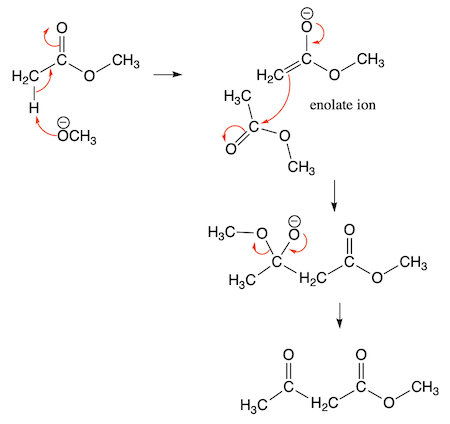
Question: Outline the reaction mechanism of below fact:
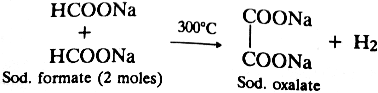
Solution:
When sodium methanoate (sodium formate, \text{HCOONa}) is heated rapidly to high temperatures between 360 °C and 420 °C, it undergoes thermal decomposition via an intramolecular or intermolecular dehydrogenation coupling reaction to form sodium oxalate (\text{Na}_2\text{C}_2\text{O}_4) and hydrogen gas (\text{H}_{2}). [1, 2]
\text{2\ HCOONa}\xrightarrow{\Delta }\text{Na}_{2}\text{C}_{2}\text{O}_{4}+\text{H}_{2}\uparrow
The classic homolytic free-radical pathway proposed for this thermal decomposition involves the breaking of the weak formyl \text{C–H} bond to form highly reactive radical intermediates. [1]
The Free-Radical Mechanism
The reaction proceeds through a chain-like homolytic mechanism consisting of three core phases:
- Initiation
Thermal energy provides the activation energy necessary to break the formyl \text{C–H} bond of the formate (methanoate) ion. Homolytic fission yields a formyl radical anion (\cdot \text{COO}^{-}) and a hydrogen radical (\text{H}\cdot).
\text{HCOO}^{-}\xrightarrow{\Delta }\cdot \text{COO}^{-}+\text{H}\cdot
- Propagation
The generated radicals quickly react with the remaining intact methanoate ions to sustain the chain:
-
Hydrogen Radical Attack: A highly reactive hydrogen radical abstracts another hydrogen atom from a neighboring formate ion, forming stable molecular hydrogen gas and generating another formyl radical anion.
\text{H}\cdot +\text{HCOO}^{-}\rightarrow \text{H}_{2}\uparrow +\cdot \text{COO}^{-} [1] -
Radical Dimerization (Coupling): Due to the high density of radical species in the molten phase, two carbon-centered formyl radical anions (\cdot \text{COO}^{-}) undergo a coupling reaction to form the carbon-carbon (\text{C–C}) bond of the oxalate dianion.
\cdot \text{COO}^{-}+\cdot \text{COO}^{-}\rightarrow {}^{-}\text{OOC}-\text{COO}^{-}\quad (\text{Oxalate\ Ion}) [1, 2]
- Termination
The chain reaction slows down and terminates when the remaining free radicals combine without generating new radical species:
\text{H}\cdot +\text{H}\cdot \rightarrow \text{H}_{2}
\cdot \text{COO}^{-}+\text{H}\cdot \rightarrow \text{HCOO}^{-}
Key Operational Parameters
-
Temperature Control: The optimum temperature window is 400 °C to 420 °C. If the temperature exceeds 440 °C, the newly formed sodium oxalate will break down further into sodium carbonate (\text{Na}_2\text{CO}_3) and carbon monoxide (\text{CO}). [1, 2]
-
Heating Rate: Rapid heating is strictly required. Slow heating allows a side reaction to dominate, converting sodium formate directly into sodium carbonate and carbon monoxide without yielding oxalate. [1, 2, 3]
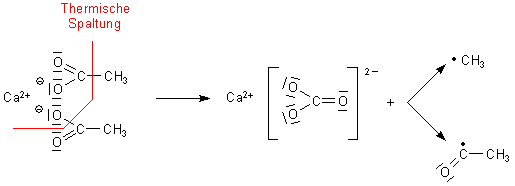
Question: calcium carboxylate, when heating, will produce CaCO3. Draw its reaction mechanism.
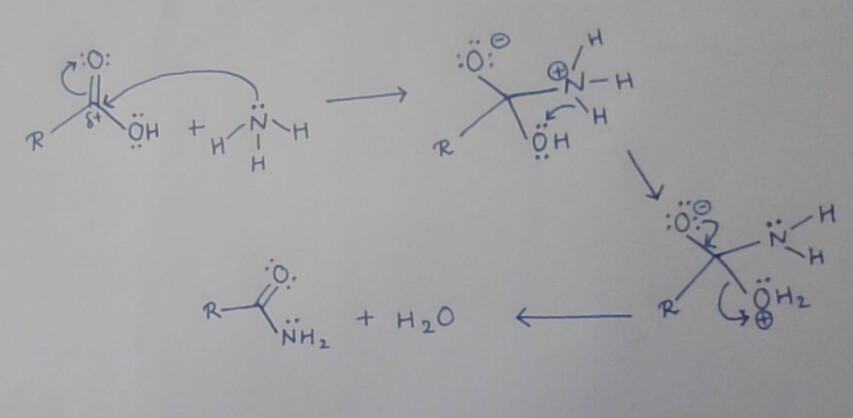
Question: How is ammonium carboxylate converted to amide when heating?
Question Outline Hunsdiecker reaction where alkyl group is added to a carboxylate.


