Question:
Show that 0 • 0 = 0
Question:
Show that 0 • 0 = 0
Solution:
0 • 0 = 0 • (x - x) for any x=/=0
Then 0 • (x - x)
= 0 • x - 0 • x = 0
Now 0 • x = 0 + 0 • x = 0 • x
LHS = RHS
Q.E.D.
Another Question:
Find the value of sinx, cosx, tanx as consecutive values such that they form both arithmetic sequences and geometric sequences, given 0<x<90°.
Solution:
We have 2 equations:
sinx + tanx = 2 cosx
sinx • tanx = cosx • cosx
Solving, we have sinx = tanx
Without loss of generality,
we take r= cosx, then:
Then:
we have r = 1 or -1 (rejected)
Noticing the given equations again:
Then we have r=/=1,
which is inconsistent.
Therefore, no solution for r. The given sequences do not exist.
Solution:
0 is the multiple of everything.
Put θ=0,
then tanθ=sinθ=sin2θ=0
So the proof is screwed.
Another Question:
Denote 0<x<90°
Show that sinx < x < tanx
Solution:
Consider sinx and x,
divide both by sinx,
since 0 < sinx < 1,
we have 1 < x/sinx
rearrangement makes sinx < x
Now consider x and tanx,
recall tanx = sinx/cosx
since 0 < cosx < 1,
and sinx is strictly increasing,
plus cosx is strictly decreasing,
obviously sinx < tanx
To continue the proof,
we take radian measures.
Given tan(π/4)= 1,
and since π/4 < 1,
as tanx is strictly increasing,
we have x < tanx
The above proof is not rigorous because HKDSE Math Core does nothing with differential calculus. 
If we use HKDSE M2 skillset, the inequality will be straightforward.
Given sinx, x and tanx are monotonic increasing under the given domain, we shall simply compare their slopes:
Q.E.D.
Another question:
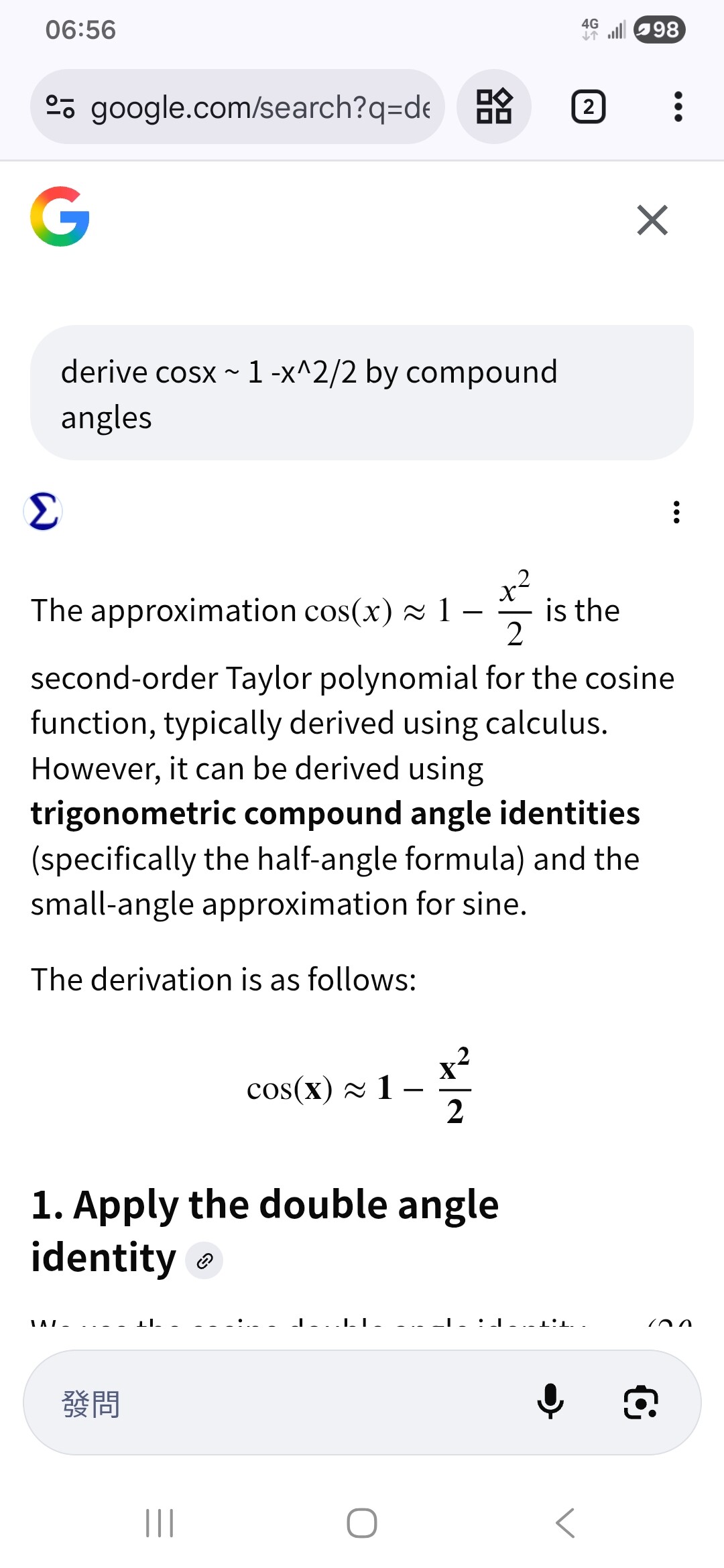
Solve cos(cos(cos(...cos(x)))) using small value approximation.
Solution:
The recursion can be simplified as solving cos(x) = x
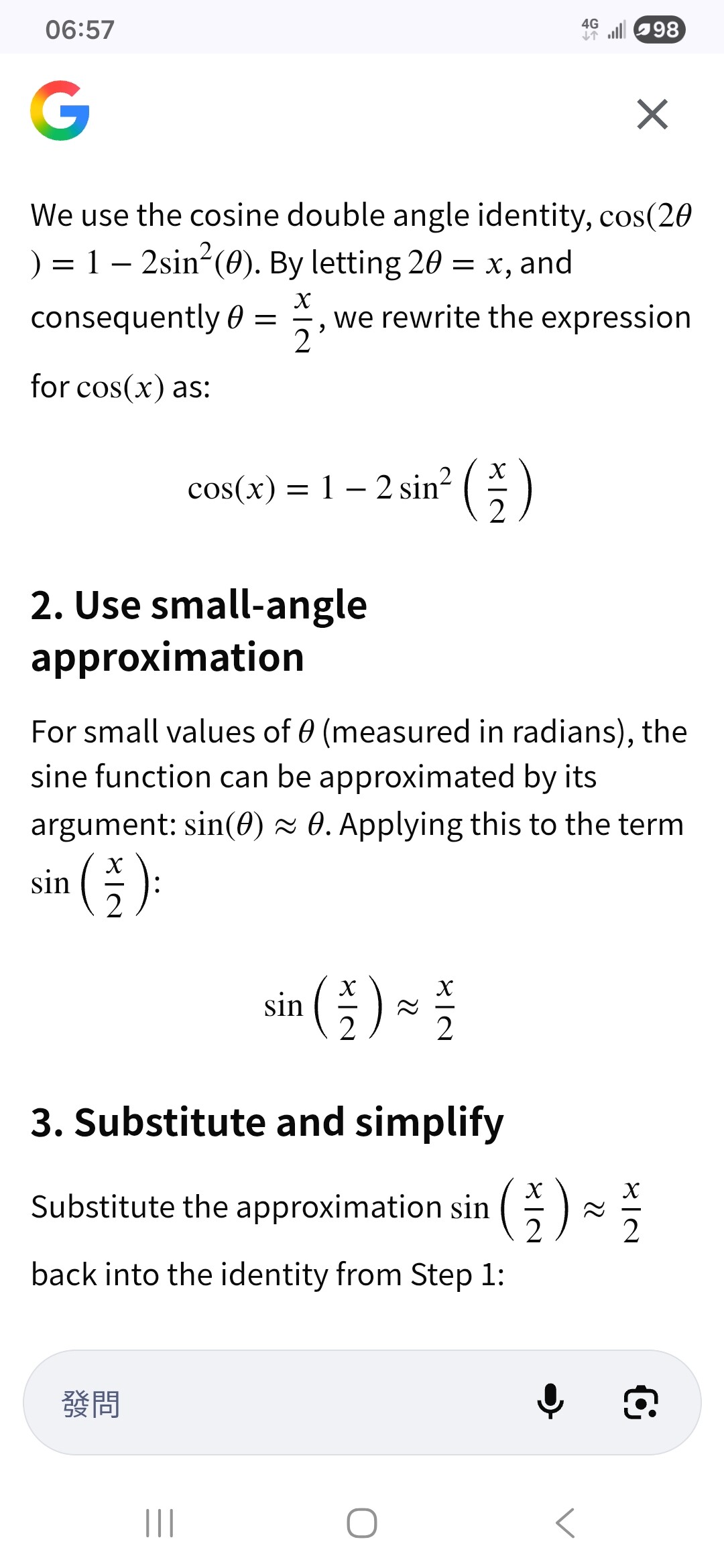
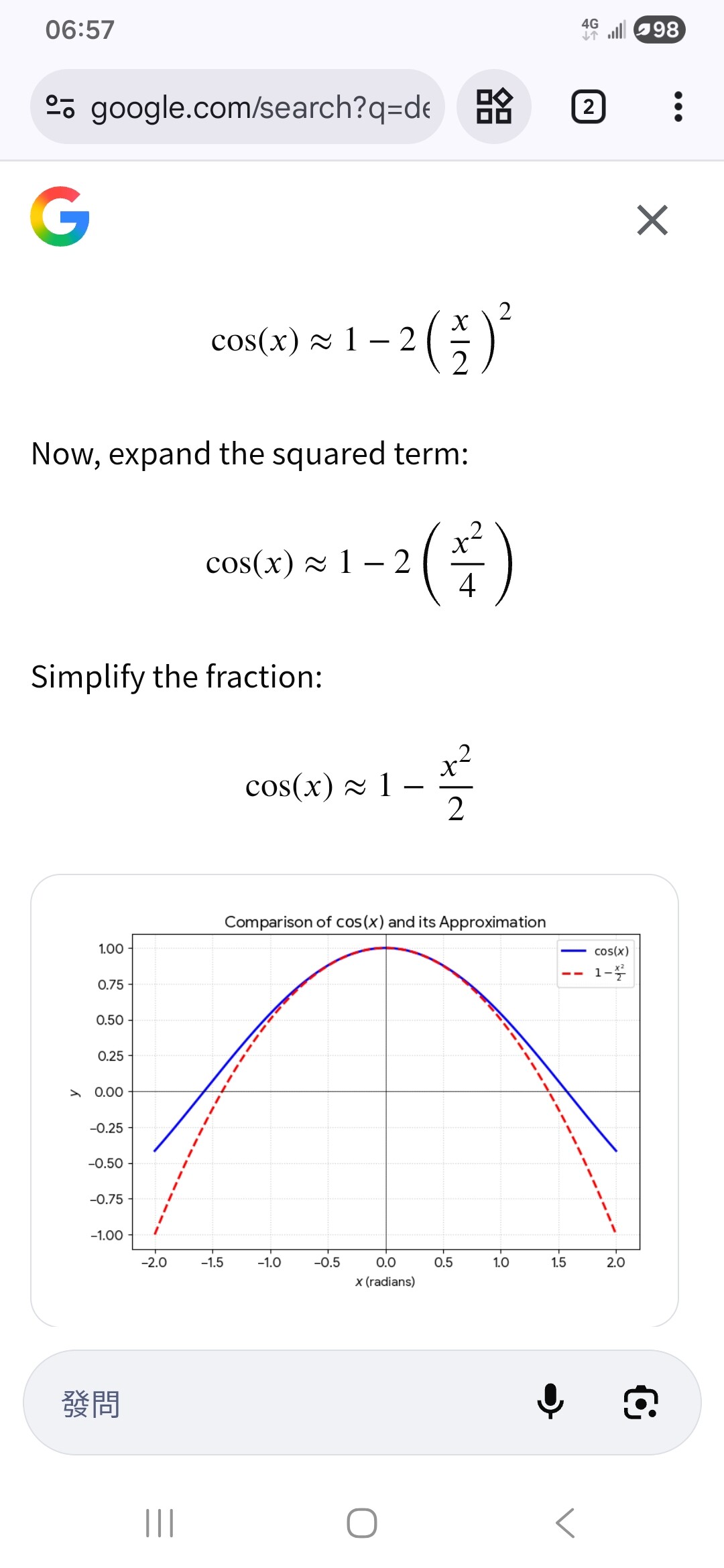
Using compound angle formulae and the fact that sin(x) ~ x when x is small enough, we can see:
The remaining step is straightforward.
Postscript: Learn how to ask AI
Another question:
\int_{}^{} cos(x^{2}) dx= ?
Solution:
Using small value approximation:
This works when x is small enough.
Another question:
Solve x^{2} < 0
Solution:
Assume there are complex solutions, we take x = a + bi
then x^{2} = a^{2} + b^{2}
= a^{2} - (ib)^{2}
Solving, we have:
-ib < a < ib
which is nonsense because ib and -ib are purely imaginary while a is real.
No solution then.
Another question:
初中程度
Explain why all perfect squares greater than 1 are always divisible by 3 or in form of 3N+1, where N is some positive integer.
Solution:
If the perfect square is not a multiple of 3, it is easy to show than (3N+1)-1 must be composite numbers, i.e. a product of 2 rational numbers:
Take C^{2} =3N+1,
clearly by known identities,
for C and N being rational:
which must be also rational.
Alternative proof:
We shall prove by contradiction. Suppose the below proposition is true: A perfect square is in the form 3N+2 where N is some positive integer.
Denote D^{2}= 3N-2,
we have 2 composite numbers:
and
which must not be rational.
Also, it suffices to show that D is even not a rational number:
Suppose there is a number X = D^{2}-2 being both multiple of 3 and perfect square, then there should also be a perfect square Y = D^{2}+1 being another multiple of 3, but by Pythagoras theorem, if D>0, Y must not be a perfect square, so both D and \sqrt{Y} must be irrational, which contradicts the proposition that D is rational.
Q.E.D.
Further reading:
We have 1 = 0 + 1,
and 5^{2} = 4^{2} + 3^{2}
So any positive perfect square plus 1 will NOT yield another perfect square.