Another question (basic M2 level)
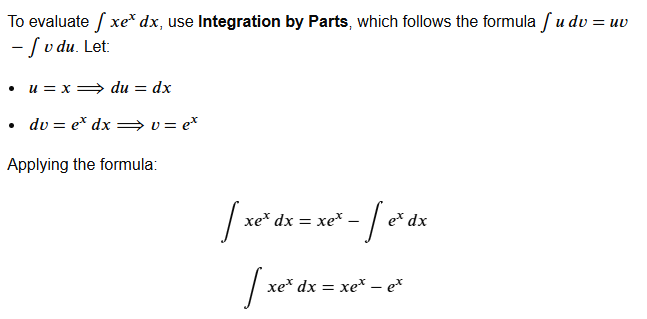
integrate 2e^x +xe^x
Another question (basic M2 level)
integrate 2e^x +xe^x
Further question:
Consider a function f(x) being differentiable over the domain [0, +∞) and f(0) = 0. The inverse function of f(x) is g(x). If:
Find f(x).
Solution:
g[f(x)]f'(x) = 2xe^x + x^2e^x
Since g[f(x)] = x, we have:
xf'(x) = 2xe^x + x^2e^x
For x =/= 0, we have:
f'(x) = 2e^x + xe^x
Integrating, we have:
f(x) = (x+1)e^x + C
Since f(x) is continuous at x=0,
putting limit for x -> 0+,
we have f(0) = 0 and thus C = -1
i.e. f(x) = (x+1)e^x -1
Another question:
Given:
and
Then when x approaches 0, do f(x) and g(x) have the same degree? Explain briefly.
Solution:
Consider
By L'Hospital's Rule, we have:
So the answer is in the negative.
Now we have freshman level math. MVT goes first:
Question: Denote f(x) as a twice-differentiable function at domain [a,b] and f(a)=f(b)=0. Prove that there exists a point c ∈ (a,b) such that:
Solution:
If f(x)≡ 0, the conclusion is trivially true.
Now consider:
where x_0 ∈ (a,b), i.e. f(x) attains maximum when x = x_0.
Also , since f(x) is twice-differentiable, we have f'(x_0) = 0. Now we expand the second-degree Taylor series for f(x) at x = x_0 with Lagrange's form of remainder, we have:
where
d = x_0 + g(x-x_0) and 0<g<1.
Since f(a) = 0, put x = a into the above series, we have:
where a < h < x_0.
Now,
Likewise:
where x_0 <j < b.
Then for:
we apply AM-GM inequalities such that:
where the equality holds if and only if x_0 = \frac{a+b}{2}.
Q.E.D.
Now try one more:
Question: Let f(x) be a twice-differentiable function at domain [0,1] satisfying |f(x)|≤ a and |f"(x)|≤ b where both a and b are non-negative constants. Denote c as any point within domain (0,1), prove that:
Solution:
Using the same trick from the previous question, we have:
where d = c + g(x-c), 0 < g < 1.
(Recall what a position vector looks like)
Put x=0, we have:
where 0<h<c<1
Put x=1, we have:
where 0<c<j<1
Subtracting each other, we have:
Then by triangle inequalities:
Note that for 0<c<1, (1-c)^2 + c^2≤ 1
Q.E.D.
Now try 5 more questions on mean value theorem for integral calculus:
Answers in English will be announced later.
Solution to MVT(IC) Question 1:
Since f(x) is differentiable on interval [a,b], f(x) is also continuous on interval [a,b], then F(x) = f(x) cosx is continuous on interval [a, \frac{a+b}{2} ]. By MVT(IC), there exists a point c ∈ [a, \frac{a+b}{2} ] such that:
On interval [c.b], by Rolle's Theorem, there exists at least a point d ∈ (c,b) ⊂ (a,b) such that:
Rearranging gives:
Q.E.D.
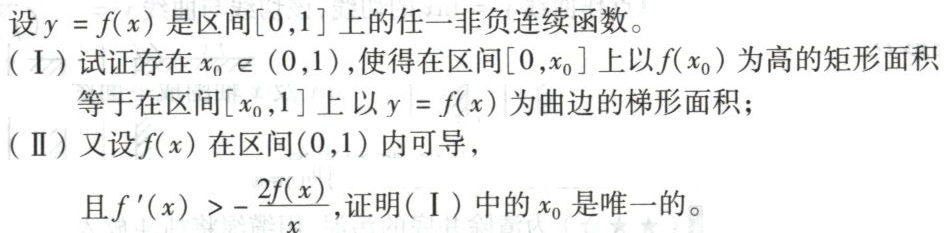
Solution to MVT(IC) Question 2:
Part (I):
The question is equivalent to proving:
Now let:
Then g(x) is continuous on domain [0,1] and differentiable on interval (0,1). Also, since g(0) = g(1) = 0, by Rolle's Theorem again, there exists x_0 ∈ (0,1) such that:
i.e.
The above proof uses the method of auxiliary function.
Part (II):
Denote:
Given:
Then:
Then F(x) is strictly increasing on domain (0,1).
So the value of x_0 is unique.
Solution to MVT(IC) Question 3:
Denote
where 0\le x \le \pi.
Then F(0) = 0 and F(\pi) = 0.
Also, since:
0 = \int_{0}^{\pi} f(x)cosx dx = \int_{0}^{\pi} cosx dF(x) = \int_{0}^{\pi} F(x)sinxdx ...(*)
So there exist c ∈ (0, \pi) such that F(c)sinc = 0;
otherwise, in the domain (0, \pi),
F(x)sinx > 0 or F(x)sinx < 0, which contradicts the fact (*).
Note that for c ∈ (0, \pi) , sinc \neq 0, so F(c) = 0.
Then for F(x), for domains [0,c] and [c, \pi], applying Rolle's Theorem, there exists at least one point m ∈ (0, c) and one point n ∈ (c, \pi) such that F'(m) = F'(n) = 0, i.e. f(m) = f(n) = 0.
Done.
Solution to MVT(IC) Question 4:
Using integration by part:
Since f'(x) is continuous. it has a minimum m and maximum M on domain [0,a] such that:
So:
Also, by Intermediate Value Theorem, there exists at least one point c ∈ [0,a] such that:
Hence,
Solution to MVT(IC) Question 5:
Denote:
Then we are going to prove that:
i.e.
In fact, by triangle inequalities:
Q.E.D.
Solution to MVT(IC) Question 6:
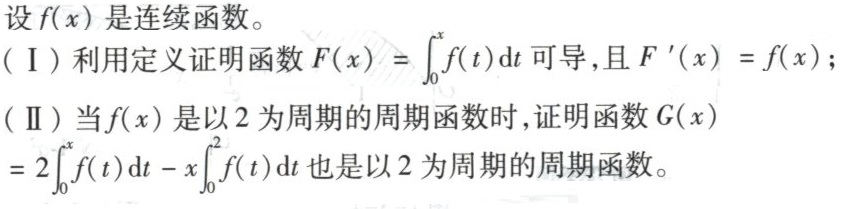
Part (I):
Using the definition of an derivative:
Since f(x) is continuous, by Intermediate Value Theorem for Integral Calculus, there exists c ∊ (x, x + \Delta x) such that:
So:
Part (II):
For periodic function, f(x+2) = f(x) such that:
G'(x+2) = G'(x)
Integration gives:
G(x+2) - G(x) = C
Put x = 0, C = G(0+2) - G(0) = 0
So G(x+2) = G(x).