Now we focus on ordinary differential equations (ODE), which is relevant to HKALE Applied Mathematics and even Pre-1985 HKALE Pure Mathematics.
Question:
An aeroplane is landing on an airport. To reduce the sliding distance, when the plane touches the land, the back of the plane instantaneously opens the speed-retarding parachute such that the air resistance engendered slows down the plane rapidly until becoming stationary.
Given the mass of the plane 9000 kg, and the initial landing speed 700 km/h, if the total resistance exerted on the plane is proportional to the velocity of the plane (ratio k = $6.0 x 10^6), evaluate the greatest sliding distance of the plane.
Solution (without ODE) :
Given m = 9000 kg and v_0 = 700 km/h, denote the landing distance as x(t) and the velocity v(t) = x'(t).
By Netwon's second law in mechanics, we have:
m\frac{dv}{dt} = -kv
By chain rule of differentiation, we have:
\frac{dv}{dt} = \frac{dv}{dx} ‧ \frac{dx}{dt} = v \frac{dv}{dx}
Combined, we have:
dx = -\frac{m}{k} dv
Integrating, we have:
x(t) = -\frac{m}{k}v+C
Known that v(0) = v_0 and x(0) = 0, we have:
C = \frac{m}{k}v_0
Now:
x(t) = \frac{m}{k}[v_0 - v(t)]
Put v(t) \to 0, we have:
x(t) \to \frac{mv_0}{k} = 1.05 km
Solution (with ODE) :
Clearly it is first order ODE like exponential decay in atomic physics. By separation of variables, we have:
m\frac{dv}{dt} = -kv
\frac{dv}{v} = -\frac{k}{m}dt
Integrating, we have the special solution:
v = Ce^{-\frac{k}{m}t}
Plugging the initial conditions, we have:
v|_{t=0} = v_0 \to C =v_0
v(t) = v_0e^{-\frac{k}{m}t}
Now:
x = \int_{0}^{+\infty} v(t) dt
= -\frac{mv_0}{k}e^{-\frac{k}{m}t} |_{0}^{+\infty} = \frac{mv_0}{k}
Q.E.D.
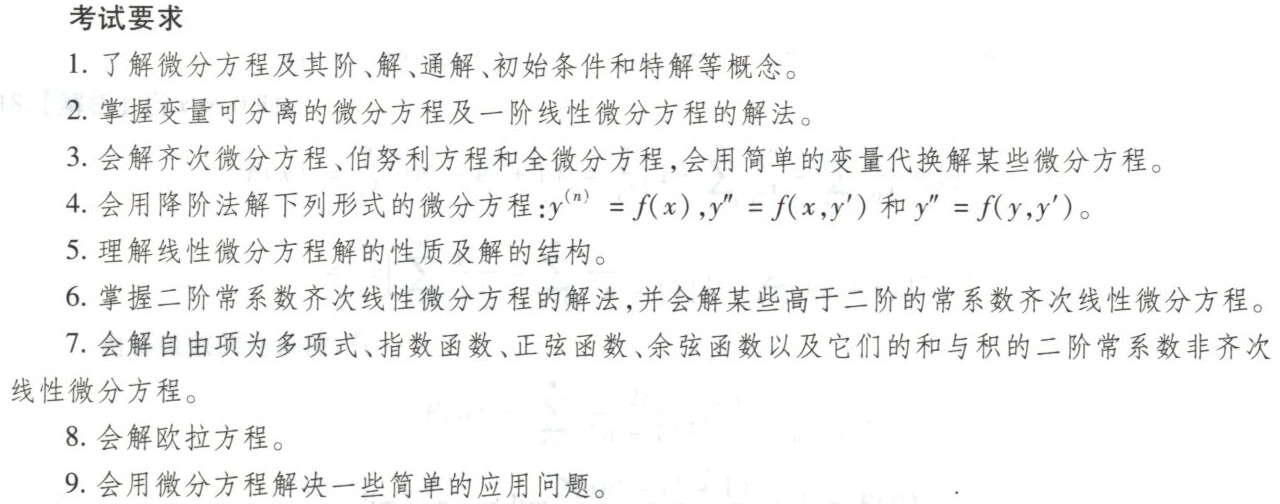
Below is the curriculum of undergraduate level ODE for engineering sciences in PRC:
Break a leg.