Question:
Given that when n^2 is divided by 3, the remainder is always either 0 or 1, where n is any positive integer. Prove that for any positive real number m, 3m+2 cannot be a perfect square.
Hint: Try to complete thr square(s).
Question:
Given that when n^2 is divided by 3, the remainder is always either 0 or 1, where n is any positive integer. Prove that for any positive real number m, 3m+2 cannot be a perfect square.
Hint: Try to complete thr square(s).
Hints:
From the given information, when n is not a multiple of 3, the remainder of n^2 must always equal to 1 i.e. n^2 = 3h + 1 for any positive integer h.
Now,
3m+2 = 3h + 1 + 1
=n^2 + 3k + 1
for any positive integer k and n NOT being any multiple of 3.
For 3m+2 being a perfect square:
3m+2 = (n+1)^2
=n^2 + 2n + 1
i.e. 3k = 2n
Since both k and n are positive integers, n must be a multiple of 3, which contradicts with given conditions.
So the square root of 3m+2 must be irrational. Q.E.D.
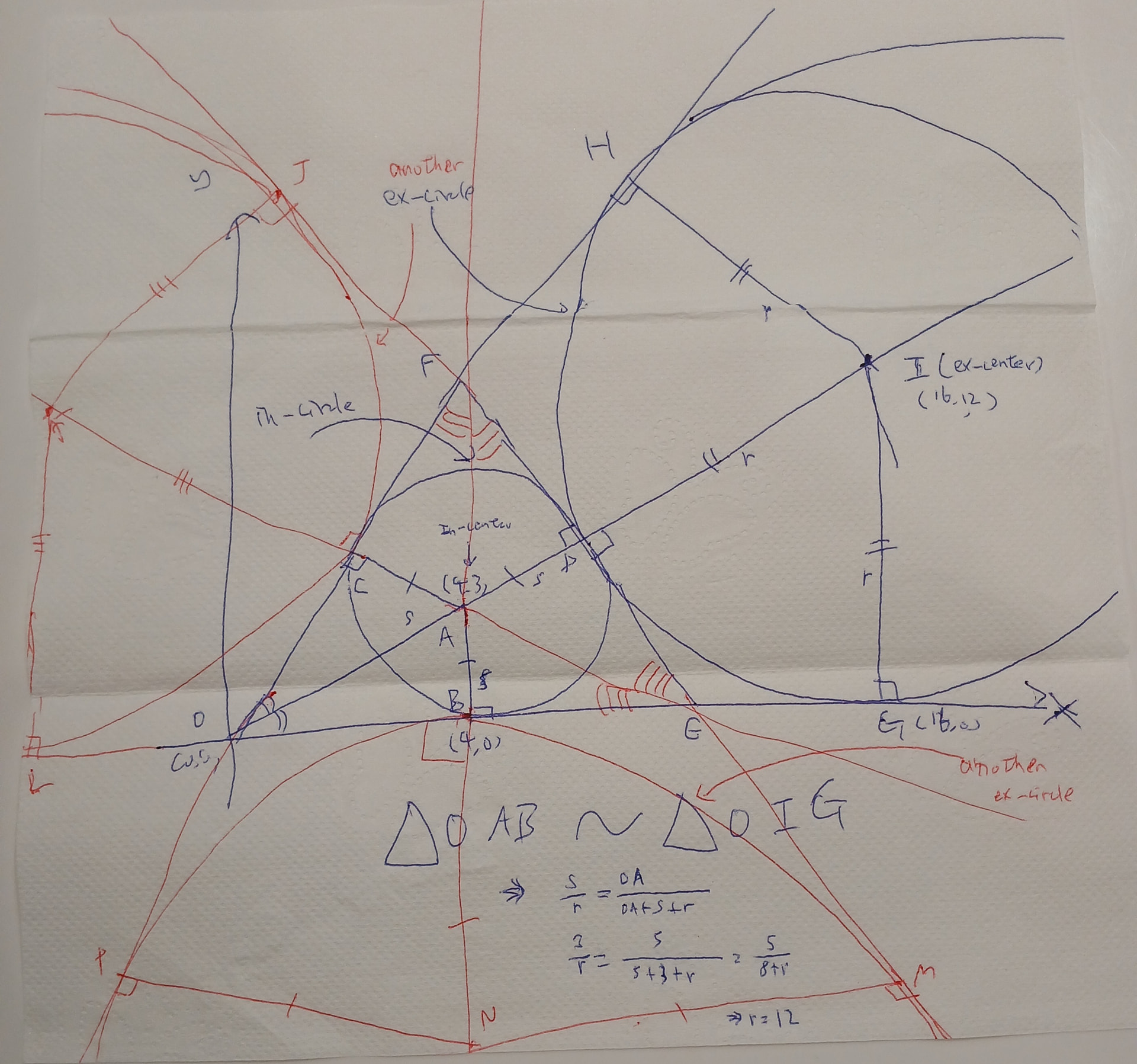
Try compute an excentre using similar triangles.
Note that we can also show that all perfect squares other than multiples of 3 must have remainder exactly equals 1.
Denote n as any multiple of 3, we have 3 cases of perfect square:
Case 1: n^2
This case is fucking obvious.
Case 2: (n+1)^2
Expand it,
we have n^2 + 2n + 1
Fucking obvious again.
Case 3: (n+2)^2
Expand it,
we have n^2 + 4n + 4
Note that 4=3+1.
Q.E.D.
Now, using the same nature of n, we deal with remainders of cubes. The first case is trivial.
Case 2: (n+1)^3
The constant term is 1.
The remainder of 4^3 is then 1.
Case 3: (n+2)^3
The constant term is 2^3=8
The remainder of 5^3 is then 2.
Another question:
Show that for any real positive integer x:
(x)(x+1)(x+2)(x+3) + 1 = n^2 for some positive integer n.
Solution:
By expanding the polynomial, we have:
x^4 + 6x^3 + 11x^2 + 6x + 1
= x^4 + 6x^3 + 9x^2 + 2x^2+ 6x + 1
= x^2 (x+3)^2 + 2x (x+3) + 1
= [x(x+3)]^2
Done.
Another question:
Explain why \frac{1}{x^2+1} is NOT a polynomial.
Solution:

The leading coefficient is NOT finite.
Q.E.D.
Notice that |x|<1 for the above power series.
Also, since x^∞=0, the leading coefficient is equivalent to zero as the leading term (the greatest degree) is made zero. All these defy the definitions of a polynomial.
Erratum:
The last line should be [x(x+3)+1]^2.
The degree of this expression is NOT positive, or you can say that it even does not have a degree.
Likewise, ln(x) and e^x have no degree such that they must be dimensionless.