Question:
Given ab>0.
(a) Show that the matrix A =\begin{pmatrix} a & -1 \\ b & 1 \end{pmatrix} is non-singular.
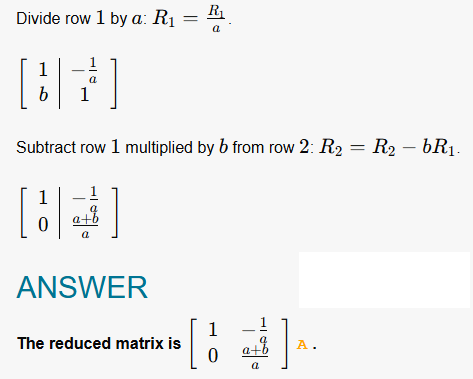
(b) Using Gauss-Jordan elimination, evaluate the inverse A^{-1} .
Question:
Given ab>0.
(a) Show that the matrix A =\begin{pmatrix} a & -1 \\ b & 1 \end{pmatrix} is non-singular.
(b) Using Gauss-Jordan elimination, evaluate the inverse A^{-1} .
Solution:
(a) If A is singular, then det(A)=a+b=0
i.e. a= -b and ab <0, which contradicts with given conditions.
So A is non-singular.
(b)
Question:
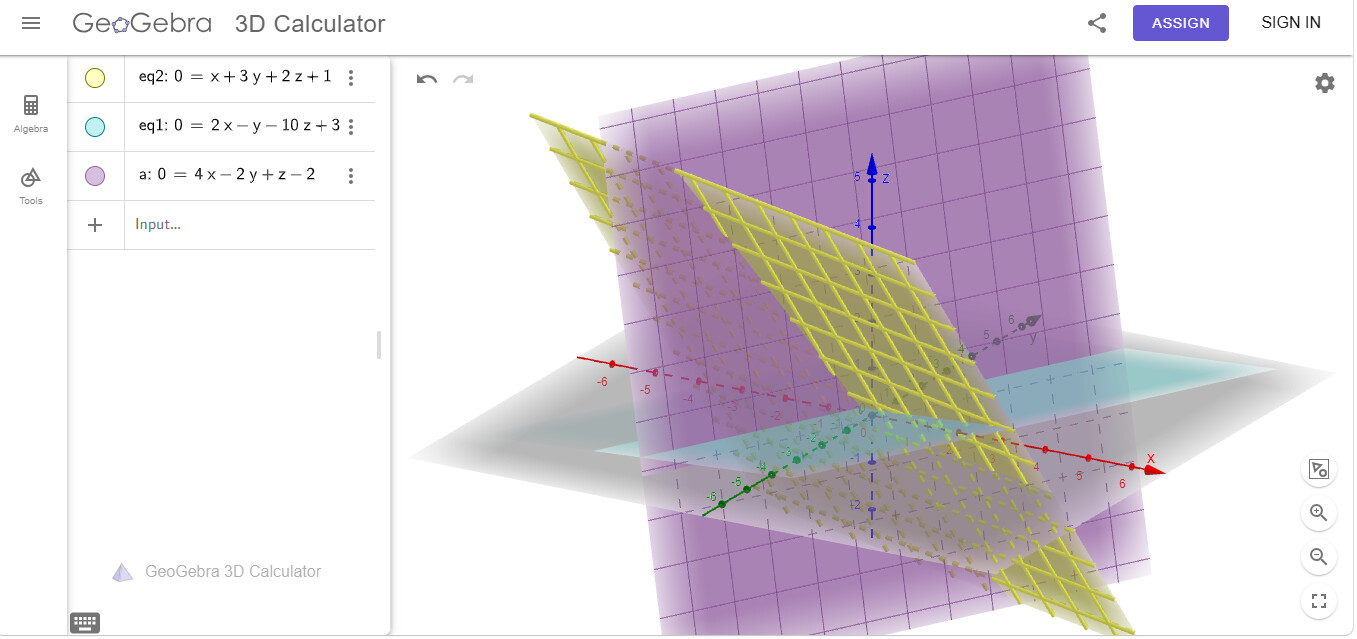
Given a straight line L = \left\{ \begin{array}{cl} x + 3y + 2z + 1 = 0 \\ 2x - y - 10z + 3 = 0 \end{array} \right.
and a plane \Pi: 4x - 2y + z -2 = 0.
Show that L \perp \Pi.
Solution:
The direction vector of L is:
The normal vector of \Pi is:
Note that \overrightarrow{s} // \overrightarrow{n}.
Q.E.D.
Question:
Given a matrix A = \begin{vmatrix} 1 & 0 & 2 & 0 \\ 0 & -2 & 0 & 0 \\ -1 & 0 & 1 & 0 \\ 0 & 0 & 0 & 1 \end{vmatrix}.
Also, a matrix $B satisfies AB + B + A + 2I = \textit{0}.
Evaluate |B+I|.
Solution:
Rearranging the terms, we have:
By factorization with identity matrix I:
Taking the magnitude, we have the following determinants:
Now:
So |B+I| = -1/12.
Question:
Given the matrix A = I - 2RR^T,
where R = (x_1, x_2, ..., x_n )^T and R^TR = 1.
(a) Prove that A is a symmetic matrix.
(b) Prove that A^2 is unit matrix.
(c) Prove that A is an orthogonal matrix.
(d) Prove that A is invertable.
Solution:
(a) A^T = (I - 2RR^T)^T = I^T - (2RR^T)^T = I - 2RR^T = A.
Transpose of a Matrix - GeeksforGeeks
(b) A^2 = (I - 2RR^T)(I - 2RR^T) = I - 4RR^T + 4RR^TRR^T
=I - 4RR^T + 4R(R^TR)R^T = I.
(c) From (a) and (b),
A^2 = AA^T = I.
(d) From (c), A^{-1} = A^T \neq 0.