Question:
Consider the reaction below:
SO_3^{2-} + S \to S_2O_3^{2-}
What condition is missing?
Question:
Consider the reaction below:
SO_3^{2-} + S \to S_2O_3^{2-}
What condition is missing?
Solution:
Heat. S is in excess.
Question:
Thiosulphate ions will decolourize an aqueous Iodine solution. Write out the ionic equation for this reaction.
Solution:
2S_2O_3^{2-} (aq) + I_2 (aq) \to S_4O_6^{2-} (aq)+ 2I^{-} (aq)
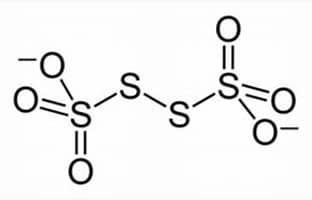
Question:
Draw the Tetrathionate anion.
Question:
What anion can be easily found in paints and pigments?
Solution:
Sulphate(VI) ions
Question:
What reducing agents can be used to break down the peroxy bond in persulphate ions?
Solution:
Iodine and Manganese(II) ions
S_2O_8^{2-} (aq) + I_2 (aq) \to 2SO_4^{2-} (aq) + 2I^- (aq)
S_2O_8^{2-} (aq) + Mn^{2+} (aq) + 2H_2O (l) \to 2SO_4^{2-} (aq) + 4H^+ (aq) + MnO_2(s)
Question:
What is the nature of the below redox reactants?
(a) FeCl_3 + H_2S
(b) S_2O_3^{2-} + 2H^+
Solution:
(a) Reduction of Fe^{3+} ions
(b) Disproportionation
Both reactions will produce sulphur solids.
Question:
Name 2 common sulphur ores.
Solution:
Iron(III) pyrite Fe_2S_3
Zinc blende ZnS
Question:
Suggest a common industrial method to remove:
(a) Moist
(b) Dust
Solution:
(a) H_2SO_4 (l)
(b) Electrostatic precipitator.
Question:
When heating FeSO_4, both SO_2 and SO_3 will be liberated but Fe_2(SO_4)_3 not. Explain briefly.
Solution:
Fe_2(SO_4)_3, upon heating, will liberate SO_2 and O_2. From this, we can say that in FeSO_4, upon heating, Fe^{2+} ion will reduce O_2 originally liberated into sulphur oxides.
Question:
Some say that the oxidation number of Fe_3O_4 is +\frac{8}{3}. Prove that he is on9.
Solution:
Fe_3O_4 = FeO + Fe_2O_3
So it is a mixture.