Question:
Name the chemicals used to test for Fe^{2+} and Fe^{3+} ions respectively.
Question:
Name the chemicals used to test for Fe^{2+} and Fe^{3+} ions respectively.
Solution:
Fe(CN_6)_3^{3-}
It is yellow hexacyanoferrate(III) or ferricyanide ion which will be converted to Prussian blue hexacyanoferrate(IV) or ferrocyanide ion (Fe(CN_6)_3^{4-}) when reacting with Fe^{2+} ion.
K(SCN)_3 (aq)
It will form a deep-red precipitate when reacting with Fe^{3+} ion.
Question:
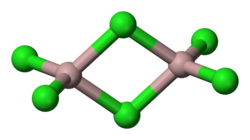
Anhydrous FeCl_3 exhibits as a dark red covalennt dimer. Draw its shape.
Question:
State the color of the following salts:
(a) Fe(NO_3)_3
(b) Fe(SO_4), i.e. ferrous sulphate
(c) Fe_3(SO_4)_2, i.e. ferric sulphate
(d) FeCl_3
Soluution:
(a) Pale violet
(b) Green, but white when anhydrous
(c) Yellow, but white when anhydrous
(d) Yelow, but dark red when anhydrous
Question:
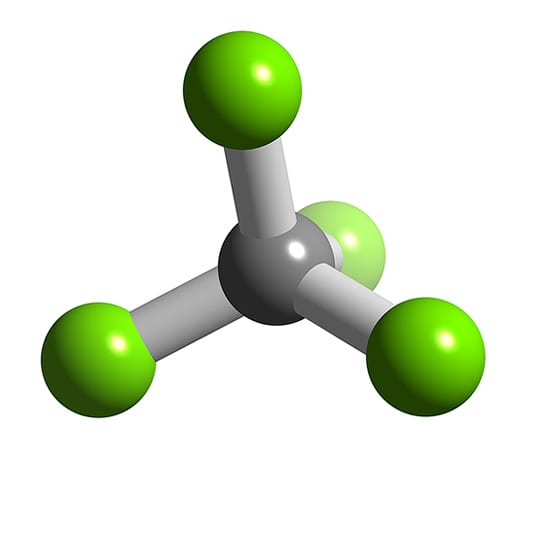
[FeCl_4]^{2-} ion looks like [AlH_4]^- ion. Draw their shape.
Question:
Write down the chemical reactions that form rusts.
Solution:
2Fe(s) + O2(g) + 2H_2O(l) \to 2Fe(OH)_2 (s)
2Fe(OH)_2(s) + 2H_2O(l) \to 2Fe(OH)_3(s) + H_2(g)
2Fe(OH)_3(s) \to Fe_2O_3‧3H_2O(s)
Question:
What is the value of y from the following crystal?
FeF_2·yH_2O
Solution:
4
Question:
What will happen when a sand is mixed with limestone at high temperature?
Solution:
CaSiO_3 and CO_2 will be produced,
Question:
Compare the toxicity between Tin and Zinc.
Solution:
Sn < Zn
Question:
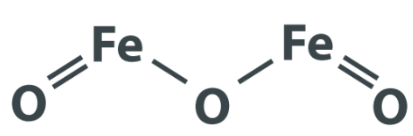
Draw the structure of haematite (an Iron ore).
Question:
Discuss how to prepare a dry FeCl_2.
Solution:
Hot Fe(s) + dry HCl(g) \to FeCl_2(s) + H_2(g)